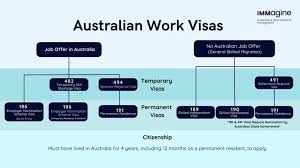
If you are considering moving to Australia as a foreign worker, understanding visa options, eligibility requirements, and employment opportunities is essential. This guide simplifies the process.
Why Skilled Migration to Australia is Popular
Australia offers several advantages to skilled migrants:
- Competitive salaries and strong worker protections
- Access to permanent residency pathways
- High quality healthcare and education systems
- Opportunities across multiple industries facing skills shortages
- A points-based immigration system that rewards qualifications and experience
Australia’s migration program continues to prioritize skilled workers, with significant places allocated for skilled migration pathways.
Main Skilled Migration Visa Types
1. Skilled Independent Visa (Subclass 189)
The Skilled Independent Visa is one of the most desirable pathways because it does not require employer sponsorship or state nomination.
Key Features:
- Permanent residency from the beginning
- No employer sponsorship required
- Freedom to live and work anywhere in Australia
- Highly competitive selection process
This visa generally suits candidates with stronger points scores and occupations listed on Australia’s long-term skilled occupation lists. Competitive invitations often require significantly more than the minimum points threshold.
2. Skilled Nominated Visa (Subclass 190)
This pathway requires nomination by an Australian state or territory government.
Key Features:
- Permanent residency visa
- State nomination adds additional points
- Applicants usually commit to living in the nominating state temporarily
This option is often attractive for candidates who need extra points to strengthen their application. State nomination typically adds 5 points.
3. Skilled Work Regional Visa (Subclass 491)
The Subclass 491 visa encourages migrants to live and work in regional areas.
Key Features:
- Valid for five years
- Additional points advantage
- Pathway to permanent residency after meeting requirements
Regional pathways often offer lower competition and stronger opportunities for candidates with moderate scores. State or family sponsorship can provide 15 additional points.
Basic Requirements for Skilled Migration
Although requirements vary slightly depending on visa type, most applicants must satisfy these conditions:
Age Requirement
Applicants generally must be under 45 years old when submitting their application.
Skills Assessment
A positive skills assessment is mandatory for most skilled migration pathways. Your qualifications and work experience are assessed by relevant professional bodies before you can proceed. Skills assessment is widely considered the foundation of successful applications.
English Language Requirements
Applicants must demonstrate English proficiency through approved tests such as:
- IELTS
- PTE Academic
- TOEFL
- OET (for certain professions)
Higher English scores can significantly improve your migration points. Superior English scores may add substantial points advantages.
Points Test
Australia uses a points-based immigration system.
Points are commonly awarded for:
- Age
- English proficiency
- Work experience
- Educational qualifications
- Partner qualifications
- State nomination
While eligibility may begin at 65 points, many successful applicants often require significantly higher scores depending on occupation demand.
High-Demand Job Opportunities for Foreign Workers
Australia continues experiencing shortages across numerous sectors.
Healthcare
Healthcare remains one of the strongest sectors for migration opportunities.
High-demand occupations include:
- Registered nurses
- Medical practitioners
- Aged care workers
- Allied health professionals
Healthcare professionals continue receiving strong invitation numbers in state nomination rounds.
Engineering and Construction
Major infrastructure projects and housing demand continue driving recruitment.
Opportunities include:
- Civil engineers
- Electrical engineers
- Construction managers
- Project managers
- Quantity surveyors
Large infrastructure spending continues creating workforce shortages in these fields.
Technology and ICT
Technology professionals remain valuable to Australia’s economy.
Popular occupations include:
- Software developers
- Cybersecurity specialists
- Systems analysts
- Data professionals
Technology occupations remain active within several skilled migration programs.
Trades and Technical Occupations
Australia continues facing shortages in skilled trades.
Examples include:
- Electricians
- Welders
- Plumbers
- Carpenters
- Mechanics
Declining apprenticeship participation has increased demand for overseas skilled workers.
Education Sector
Teachers remain highly sought after in multiple regions.
Demand exists for:
- Early childhood teachers
- Secondary school teachers
- Special education professionals
Education professionals continue appearing prominently in invitation rounds.
Step-by-Step Pathway to Skilled Migration
Step 1: Check Occupation Eligibility
Confirm whether your profession appears on relevant skilled occupation lists.
Step 2: Complete Skills Assessment
Obtain a positive assessment from the appropriate assessing authority.
Step 3: Take English Tests
Aim for higher scores to maximize migration points.
Step 4: Calculate Your Points
Estimate your score and identify opportunities to improve competitiveness.
Step 5: Submit an Expression of Interest (EOI)
Applications are generally submitted through Australia’s SkillSelect system.
Step 6: Receive Invitation and Apply
Once invited, complete medical examinations, background checks, and visa submission.
Common Mistakes Applicants Should Avoid
Many applicants face delays or rejection because they:
- Overestimate their points score
- Submit incomplete documentation
- Delay skills assessments
- Ignore state-specific requirements
- Wait too long and lose age points
Migration communities frequently emphasize that preparation and documentation accuracy significantly affect outcomes.
Skilled migration program – Immigration and citizenship
Australia’s Skilled Migration Program is the primary pathway for qualified professionals, tradespeople, and innovators to live and work in the country permanently. Managed by the Department of Home Affairs, the program uses a points-based selection system designed to address specific labor shortages and boost the economy.
The permanent Migration Program has allocated 132,240 places specifically for the Skilled Migration stream, heavily prioritizing onshore applicants who are already living and working in Australia.
Here is an overview of how the program works, the main visa pathways, and the steps to apply.
The Core General Skilled Migration (GSM) Pathways
If you do not have a specific company sponsoring your visa, the General Skilled Migration program offers three primary pathways. These visas are points-tested, meaning you must score a minimum of 65 points based on criteria like your age, English proficiency, qualifications, and work experience.
| Visa Subclass | Type | Sponsorship Requirement | Freedom of Movement |
| Skilled Independent (Subclass 189) | Permanent Resident (PR) | None required. Purely based on your skills points score. | Live and work anywhere in Australia. |
| Skilled Nominated (Subclass 190) | Permanent Resident (PR) | Requires nomination by an Australian State or Territory government. | You must live and work in the nominating state for your first 2 years. |
| Skilled Work Regional (Subclass 491) | Provisional (5-year temporary visa) | Requires state/territory nomination or sponsorship by an eligible relative living in a regional area. | Must live, work, and study in a designated regional area. Pathways to full PR after 3 years. |
Note on Employer and Innovation Pathways: Beyond GSM, you can also look into Employer-Sponsored visas (if an Australian business offers you a role) or the National Innovation Visa, which targets global leaders and exceptional talent in specialized sectors.
Step-by-Step Application Process
Navigating the skilled migration process requires completing specific prerequisites before you can actually apply for the visa itself.
1.Check the Skilled Occupation Lists: Prerequisite.
Your profession must be on Australia’s relevant Skilled Occupation List (such as the Medium and Long-term Strategic Skills List). This determines which visa subclasses you are eligible to pursue.
2.Obtain a Skills Assessment and English Test: Prerequisite.
You must have your qualifications and work history formally evaluated by the relevant Australian assessing authority for your trade or profession. You also need to clear an approved English language test (like IELTS or PTE).
3.Calculate Your Points: Prerequisite.
Ensure you meet the minimum threshold of 65 points. Points are awarded heavily for being in prime working age (25–32), having “Proficient” or “Superior” English, and possessing years of documented skilled employment.
4.Submit an Expression of Interest (EOI):Through SkillSelect.
Submit an online EOI via the government’s SkillSelect platform. This is not a visa application; it enters you into a competitive pool. If you are pursuing a Subclass 190 or 491, you will also apply for State Nomination at this stage.
5.Receive an Invitation and Apply: Final Step (60-day window).
The Australian Government runs regular invitation rounds. If your points score is high enough or your occupation is in extreme demand, you will receive an official Invitation to Apply (ITA). You then have 60 days to formally lodge your visa application and submit your verifying documents.
Pathway to Australian Citizenship
Once you hold a permanent visa (like the 189 or 190) or transition to one from a provisional visa, you are officially an Australian Permanent Resident. To convert this into Australian Citizenship, you must meet the general residence requirements:
-
Lawful Stay: You must have lived in Australia on a valid visa for the past 4 continuous years.
-
PR Status: You must have held permanent residency for at least the final 12 months of those 4 years.
-
Physical Presence: You cannot have been absent from Australia for more than 12 months total across the 4 years, including no more than 90 days in the final year before applying.
General Skilled Migration – Pathways to Aus
General Skilled Migration (GSM) is undergoing its most significant restructuring in a decade. As of 2026, the Australian government has shifted the focus from “human capital” (having a degree) to “job readiness” (already working in a critical sector).
For the 2026–27 program year, the government has maintained a high planning level of 185,000 places, with 132,240 allocated to the Skilled stream. However, the path to getting one of those places has changed.
2026 Strategy: Where the Places Are
The “General” in General Skilled Migration now increasingly means Onshore and Regional.
| Pathway | 2026 Status | Strategic Takeaway |
| Subclass 189 (Independent) | Limited & Competitive | Primarily reserved for critical “non-sponsored” sectors like Health and Teaching. Points cut-offs for other sectors remain extremely high (95+). |
| Subclass 190 (Nominated) | The “Gold Standard” | States are prioritizing applicants already living in their jurisdiction. If you are offshore, your occupation must be on the specific State Priority List. |
| Subclass 491 (Regional) | Highest Availability | The most accessible pathway for many. 2026 quotas favor those willing to commit to regional hubs like Adelaide, Perth, or the Gold Coast. |
The “New” Points Test (Coming July 2026)
A major overhaul of the points test is being phased in. If you are preparing your Expression of Interest (EOI) now, these shifting weights will determine your success:
-
Partner Skills are Critical: In the new framework, a partner with a valid skills assessment and “Superior English” can provide a massive boost—sometimes the difference between an invitation and a rejection.
-
Income as a Metric: There is a move toward awarding points for high-salary employment in Australia, rewarding those who have already “proven” their value to the local market.
-
Age vs. Longevity: Maximum points still sit in the 25–32 age bracket, but the system is being recalibrated to favor younger applicants who will contribute to the tax base for more decades.
High-Demand Sectors for 2026
If your occupation falls into these “Fast Track” categories, your minimum points requirement may be lower (starting at 65–75 points), whereas tech or accounting may require 90–100 points.
1. Construction & Infrastructure
With massive housing and rail projects underway, Carpenters, Electricians, Plumbers, and Civil Engineers are currently receiving priority invitations, especially in Western Australia and Queensland.
2. Healthcare & Aged Care
Registered Nurses (all specializations) and Aged Care workers remain the top priority. The “Essential Skills” pathway often results in invitations within weeks of EOI submission.
3. Education
Secondary and Early Childhood teachers are in such short supply that offshore applicants in these fields have some of the strongest chances for a Subclass 189 or 190.
The Migration Roadmap
1.Determine your ANZSCO Code: Step 1.
Identify your specific code and check if it’s on the Medium and Long-term Strategic Skills List (MLTSSL). If it’s only on the Short-term list, you must target the 190 or 491.
2.Max out English & Skills Assessment: Step 2.
In 2026, “Competent” English is no longer enough. You almost certainly need “Superior” (IELTS 8 or PTE 79) to be competitive in the points pool.
3.Lodge EOI via SkillSelect: Step 3.
Submit your Expression of Interest. Be honest about your points; over-claiming points that you can’t prove later results in an automatic visa refusal and potential 3-year ban.
4.State Nomination (Optional but Recommended):Step 4.
Apply directly to a state (e.g., NSW, VIC) for nomination. This adds 5 points (190) or 15 points (491) to your score and significantly increases invitation speed.
Skilled Occupation List – Office of Immigration Australia
To successfully apply for independent or state-sponsored permanent residency in Australia, your specific job must match an occupation on the official Skilled Occupation List (SOL).
Managed by the Department of Home Affairs alongside Jobs and Skills Australia (JSA), the framework is divided into three primary lists. Which list your job falls under completely dictates your available visa pathways ($189$, $190$, or $491$).
Additionally, the government utilizes the newly streamlined Core Skills Occupation List (COSL) specifically for employer-sponsored pathways like the Skills in Demand visa.
The Three Primary Skilled Migration Lists
The tables below break down the major streams, what visas they unlock, and high-demand examples for the current migration cycle.
1. Medium and Long-term Strategic Skills List (MLTSSL)
This is the highest-value list. Occupations here represent long-term, systemic shortages across Australia and grant access to all major skilled visa subclasses, including the un-sponsored independent PR visa.
-
Eligible Visas: Subclass 189 (Independent), Subclass 190 (Nominated), Subclass 491 (Regional).
| ANZSCO Code | High-Demand Occupation | Assessing Authority |
| 133111 | Construction Project Manager | VETASSESS |
| 233211 | Civil Engineer | Engineers Australia (EA) |
| 241411 | Secondary School Teacher | AITSL |
| 254412 | Registered Nurse (Aged Care) | ANMAC |
| 261313 | Software Engineer | Australian Computer Society (ACS) |
| 341111 | Electrician (General) | Trades Recognition Australia (TRA) |
2. Short-term Skilled Occupation List (STSOL)
The STSOL comprises roles facing immediate or localized shortages but not deemed long-term critical structural needs. You cannot use these for an independent 189 visa.
-
Eligible Visas: Subclass 190 (Nominated), Subclass 491 (Regional State-Nominated).
| ANZSCO Code | Occupation | Assessing Authority |
| 141111 | Cafe or Restaurant Manager | VETASSESS |
| 225113 | Marketing Specialist | VETASSESS |
| 351311 | Chef | TRA |
| 411213 | Dental Technician | TRA |
3. Regional Occupation List (ROL)
The ROL targets specific labor deficits outside major metropolitan hubs (Sydney, Melbourne, Brisbane). To use these occupations, you must commit to living and working in regional areas.
-
Eligible Visas: Subclass 491 (Regional Regional-Sponsored or Family-Sponsored).
| ANZSCO Code | Occupation | Assessing Authority |
| 121312 | Beef Cattle Farmer | VETASSESS |
| 221111 | Accountant (General)* | CPA / CAANZ / IPA (Note: Regional focus) |
| 411214 | Dental Therapist | VETASSESS |
Conclusion
Skilled migration to Australia offers foreign workers an opportunity to build successful careers while enjoying a high standard of living and long-term settlement options. Although the migration process may seem challenging at first, understanding the available visa pathways, meeting eligibility requirements, and targeting occupations in high demand can significantly improve your chances of success.